Begin of page section:
Page sections:

  • Go to contents (Accesskey 1)
  • Go to position marker (Accesskey 2)
  • Go to main navigation (Accesskey 3)
  • Go to sub navigation (Accesskey 4)
  • Go to additional information (Accesskey 5)
  • Go to page settings (user/language) (Accesskey 8)
  • Go to search (Accesskey 9)

End of this page section. Go to overview of page sections

Begin of page section:
Page settings:

English en
Deutsch de
Search
Login

End of this page section. Go to overview of page sections

Begin of page section:
Search:

Search for details about Uni Graz
Close

End of this page section. Go to overview of page sections


Search

Begin of page section:
Main navigation:

Page navigation:

  • University

    University
    • About the University
    • Organisation
    • Faculties
    • Library
    • Working at University of Graz
    • Campus
    Developing solutions for the world of tomorrow - that is our mission. Our students and our researchers take on the great challenges of society and carry the knowledge out.
  • Research Profile

    Research Profile
    • Our Expertise
    • Research Questions
    • Research Portal
    • Promoting Research
    • Research Transfer
    • Ethics in Research
    • Commission for Scientific Integrity
    Scientific excellence and the courage to break new ground. Research at the University of Graz creates the foundations for making the future worth living.
  • Studies

    Studies
    • Prospective Students
    • Students
  • Community

    Community
    • International
    • Location
    • Research and Business
    • Alumni
    The University of Graz is a hub for international research and brings together scientists and business experts. Moreover, it fosters the exchange and cooperation in study and teaching.
  • Spotlight
Topics
  • Sustainable University
  • Researchers answer
  • Work for us
Close menu

End of this page section. Go to overview of page sections

Begin of page section:
You are here:

University of Graz Faculty of Law European Training and Research Centre for Human Rights and Democracy News Crisis or Transformation?
  • About the Centre
  • UNESCO Chair
  • Research
  • Teaching
  • News
  • Events

End of this page section. Go to overview of page sections

Wednesday, 22 April 2026

Crisis or Transformation?

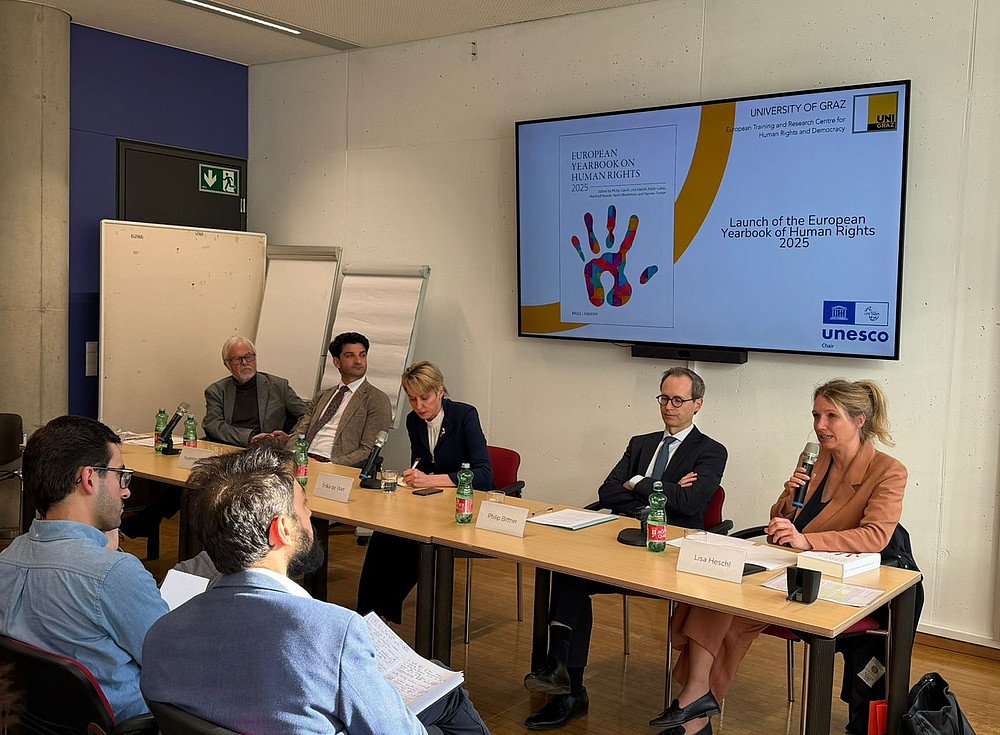
Penal ©Foto: Jetlinda Gjonaj

The Uni-ETC co-organized a panel discussion on International Law, Human Rights and the Future of Multilateralism on the occasion of the launch of the European Yearbook of Human Rights 2025

The discussion, held as part of the Heterogeneity and Cohesion Research Network (HuK-Forum), featured penalists Kushtrim Istrefi (Utrecht University School of Law), Erika de Wet (Department of International Law and International Relations, University of Graz) and Philip Bittner (Ministry for European and International Affairs) and was moderated by Wolfgang Benedek and Lisa Heschl (both Uni-ETC). 

Structured to reflect international, European, and national perspectives, the panel addressed the question whether we are witnessing the decline of multilateralism or a contested transformation towards a different configuration of international law and human rights. In her contribution, Erika de Wet forcefully appealed to the younger generation to uphold international law. Emphasizing the need for Europe to “clean up its own room first”, she argued that Europe would be better advised to focus on upholding its own values and principles rather than acting in a prescriptive manner towards other world regions. 

Kushtrim Istrefi argued that international law, human rights and multilateralism are deeply interrelated and must be addressed holistically. Describing the current period as one of regression in human rights, he identified populists leaders as key factors contributing to the pressure human rights are facing. At the same time, he highlighted often-overlooked positive developments, including strong civil society movements, growing interest in and success of strategic litigation and, perhaps surprisingly, recent polls demonstrating public support for human rights institutions such as the European Court of Human Rights. He also stressed the need for the human rights community to improve its communication and persuasive capacity in order to better convey the value of human rights to the general public.

Finally, Philip Bittner addressed the role of the Austrian state in the context of the decline of the rules-based order and multilaterlism. He highlighted several pressing challenges currently facing the international system, including geopolitical shifts, institutional shortcomings within the UN system, such as the veto power in the UN Security Council, the resurgence of sovereignty-based arguments or the distrust of the Global South towards international institutions. He also pointed to the unprecedented practice of states such as the United States of America deliberately acting outside international institutions and processes to undermine them, the ongoing funding crisis affecting international institutions, and the difficulty of reforming international mechanisms. Concluding with a focus on Austria, he underlined the importance of a functioning international legal order and the need for the Austrian government to insist on compliance with international norms and to speak out against their violations.

The panelists shared the view that, although international law and its institutions are under significant pressure, they are unlikely to disappear. However, how they will evolve and whether they will retain their relevance remains uncertain.

Prior to the discussion, Lisa Heschl presented the European Yearbook on Human Rights 2025, which was recently  published and is available open access here.

Related news

Law from the Machine?

In ancient Greek, apò mēkhanês Theós (more well-known in Latin as "Deus ex machina") describes the way mythological figures appeared in theaters seemingly from thin air, instantly influencing the plot. Today, Artificial Intelligence might exert similar effects in legal proceedings. Students from our faculty are currently taking a deep dive into this matter in a human rights moot court competition, inter alia, in Greece - and they are doing so with great success.

FreeAC: online workshop "Communicating Instruments and Strategies for Academia"

On 10 March 2026, the European Training and Research Centre for Human Rights and Democracy at the University of Graz hosted an online workshop “Communicating Instruments and Strategies for Academia” within the Erasmus+ project “Promoting Academic Freedom in Ukraine (FreeAc)”

FreeAc: online workshop "Supporting Veteran Transition into Higher Education"

On 6 March 2025, the European Training and Research Centre for Human Rights and Democracy at the University of Graz hosted an online workshop titled “Supporting Veteran Transition into Higher Education” within the Erasmus+ project “Promoting Academic Freedom in Ukraine (FreeAc)”.

Call for Papers: Human Rights Cities Against Authoritarianism and Populism

Call for Papers for the 11th Human Rights Paper Session as a part of the World Human Rights Cities Forum (WHRCF) held in Gwangju, South Korea from the 13th to the 15th of May 2026

Begin of page section:
Additional information:

University of Graz
Universitaetsplatz 3
8010 Graz
Austria
  • Contact
  • Web Editors
  • Moodle
  • UNIGRAZonline
  • Imprint
  • Data Protection Declaration
  • Accessibility Declaration
Weatherstation
Uni Graz

End of this page section. Go to overview of page sections

End of this page section. Go to overview of page sections

Begin of page section:

End of this page section. Go to overview of page sections