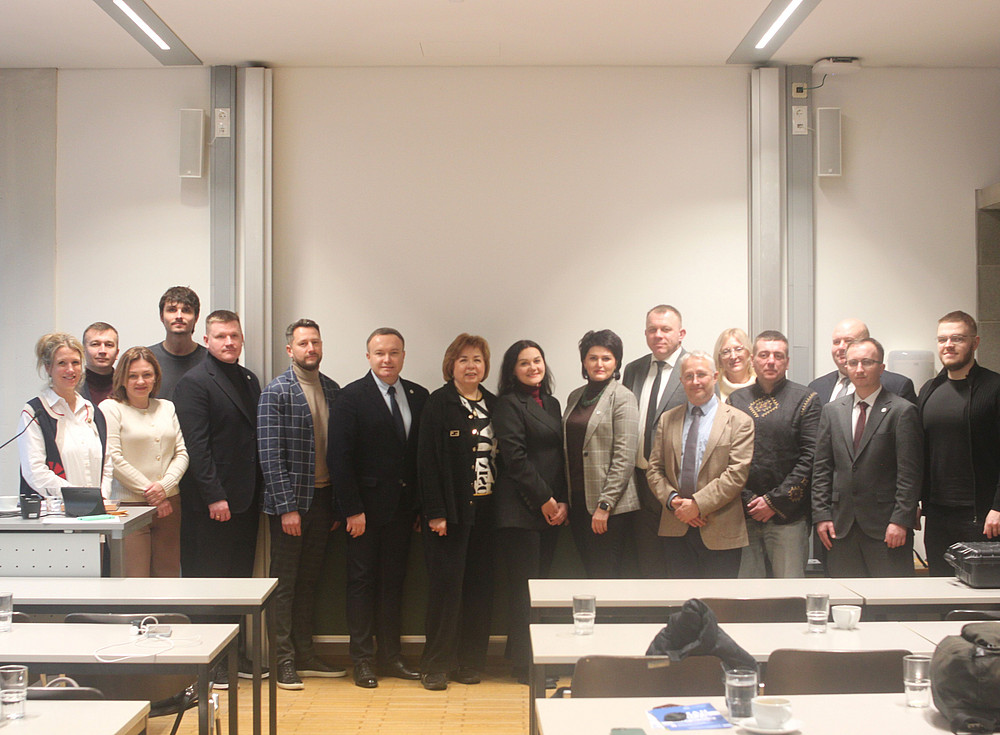
On 25.11., the City of Graz welcomed a distinguished Ukrainian study group as part of a programme organised by the Raoul Wallenberg Institute of Human Rights and Humanitarian Law (RWI). The visit focused on exploring Graz’s pioneering role as a Human Rights City and its practical implementation of human rights at the local level.
The delegation, comprising representatives from the Ukrainian Parliament Commissioner for Human Rights at regional and national levels, alongside RWI coordinators, was welcomed at the University of Graz. Klaus Starl, Director of the International Centre for the Promotion of Human Rights at the Local and Regional Levels under the auspices of UNESCO introduced the group to the operational mechanisms and impact of the City’s Human Rights Advisory Board, showcasing how Graz actively embodies its identity as a Human Rights City.
The programme also featured presentations on critical safeguarding institutions. Markus Möstl, the International Centre’s legal expert and member of the Federal Commission for the Penitentiary System and Forensic Institutions, outlined the mandate of Austria’s Ombudsman Board and the National Preventive Mechanism. Following this, Professor Gerd Oberleitner, UNESCO Chair in Human Rights and Human Security, detailed the integral work of the UNESCO Centre and Chair, stressing the necessity of a strong link between academia and municipal governance in furthering local human rights initiatives. This synergy was practically illustrated by researcher Lisa Heschl, who presented the EU-funded “FreeAC – Promoting Academic Freedom in Ukraine” project, connecting academic research directly with human rights advancement.
The day concluded with fruitful discussions among the experts, facilitated by interpreters. This exchange served to strengthen collaboration and share best practices, highlighting the essential role of partnerships in localising human rights and ensuring their tangible impact on communities.