Begin of page section:
Page sections:

  • Go to contents (Accesskey 1)
  • Go to position marker (Accesskey 2)
  • Go to main navigation (Accesskey 3)
  • Go to sub navigation (Accesskey 4)
  • Go to additional information (Accesskey 5)
  • Go to page settings (user/language) (Accesskey 8)
  • Go to search (Accesskey 9)

End of this page section. Go to overview of page sections

Begin of page section:
Page settings:

English en
Deutsch de
Search
Login

End of this page section. Go to overview of page sections

Begin of page section:
Search:

Search for details about Uni Graz
Close

End of this page section. Go to overview of page sections


Search

Begin of page section:
Main navigation:

Page navigation:

  • University

    University
    • About the University
    • Organisation
    • Faculties
    • Library
    • Working at University of Graz
    • Campus
    Developing solutions for the world of tomorrow - that is our mission. Our students and our researchers take on the great challenges of society and carry the knowledge out.
  • Research Profile

    Research Profile
    • Our Expertise
    • Research Questions
    • Research Portal
    • Promoting Research
    • Research Transfer
    • Ethics in Research
    Scientific excellence and the courage to break new ground. Research at the University of Graz creates the foundations for making the future worth living.
  • Studies

    Studies
    • Prospective Students
    • Students
  • Community

    Community
    • International
    • Location
    • Research and Business
    • Alumni
    The University of Graz is a hub for international research and brings together scientists and business experts. Moreover, it fosters the exchange and cooperation in study and teaching.
  • Spotlight
Topics
  • Sustainable University
  • Researchers answer
  • Work for us
Close menu

End of this page section. Go to overview of page sections

Begin of page section:
You are here:

University of Graz Faculty of Law European Training and Research Centre for Human Rights and Democracy News Summer School 2025 on Academic Freedom in Times of War in Poznań
  • About the Centre
  • UNESCO Chair
  • Research
  • Teaching
  • News
  • Events

End of this page section. Go to overview of page sections

Thursday, 03 July 2025

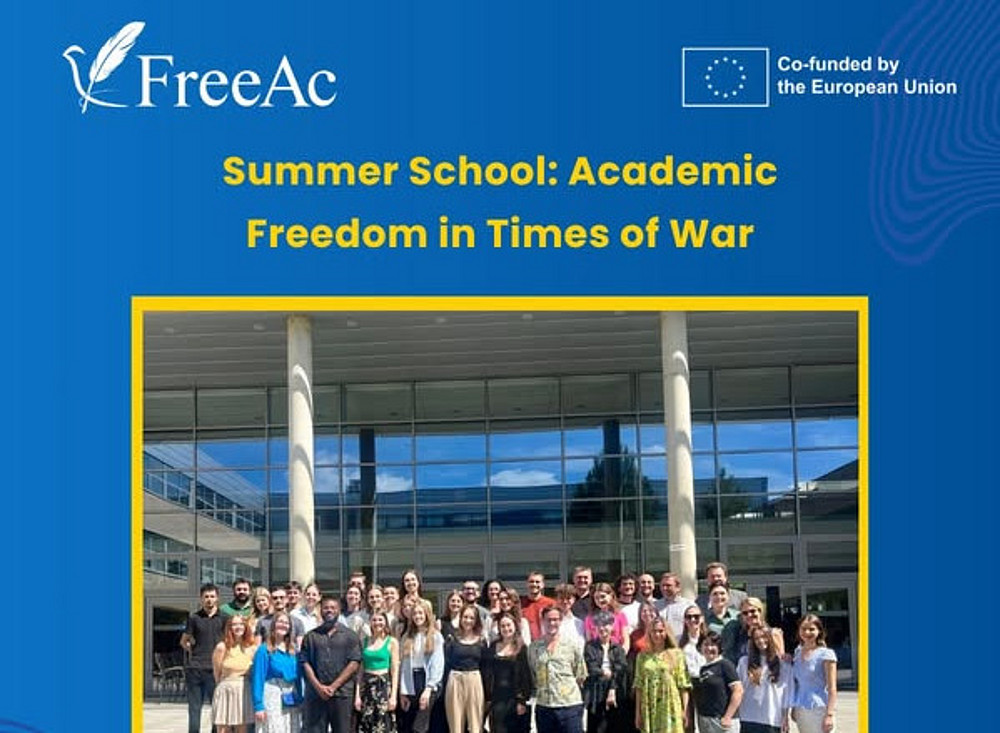
Summer School 2025 on Academic Freedom in Times of War in Poznań

Participants

From 23 to 27 June 2025, the Faculty of Political Science and Journalism at Adam Mickiewicz University (AMU) in Poznań hosted an international Summer School on Academic Freedom in Times of War. Organised within the framework of the Erasmus+ project “Promoting Academic Freedom in Ukraine (FreeAc)” (2023-1-AT01-KA220-HED-000164930), the school gathered students, lecturers, and researchers from Ukraine, Austria, Poland, Italy, and Greece for a week-long interdisciplinary exchange on the challenges and defence of academic freedom in contexts of armed conflict.

The Summer School provided a unique space for academic dialogue on the threats to higher education in wartime and offered participants diverse perspectives, legal, political, ethical, and institutional, on the role of academia in upholding democratic values and fundamental rights.

The programme began with welcoming remarks and a presentation of the FreeAc project by Lisa Heschl (University of Graz). In his keynote lecture, Professor Zbyszko Melosik (AMU) critically examined the idea and reality of academic freedom as a social construct. Throughout the week, the school combined thought-provoking lectures with interactive sessions, including group work and collaborative research.

Highlights included:

  • International and legal perspectives on academic freedom, with contributions from Prof. Gerd Oberleitner (UNESCO Chair, University of Graz), Prof. Anna Potyrała and Prof. Jędrzej Skrzypczak (AMU),

  • A case study on scientific censorship and propaganda in Russian academia by Dr. Inna Makarenko (Sumy State University),

  • Presentations of key project outputs: baseline studies, manuals on integration of displaced scholars, and joint research efforts on the impact of war on Ukrainian academia,

  • A timely session on cybersecurity and AI threats for academic freedom in Ukraine led by Petro Katerynych (TSNUK),

  • And a two-part workshop on the Academic Freedom Index, conducted by Angelo Vito Panaro (Friedrich-Alexander-University Erlangen-Nürnberg), exploring global trends and assessment methodologies.


In light of the current legal restrictions on international travel for male students and academic staff from Ukraine, as well as other challenges posed by martial law, the core lectures of the Summer School were delivered online. This format was chosen to ensure the participation of Ukrainian students in the programme, enabling them to take part in academic discussions and benefit from international exchange despite the difficult circumstances.

As an integral part of the Summer School programme, two lectures by Ukrainian researchers („Potemkin Village of Russian Science: The Case of Editorial Boards“ by Inna Makarenko (Sumy State University) and „Resilient Minds, Fragile Networks: Protecting Academic Freedom and Rebuilding Ukraine’s Higher Education Amidst Cyberwars and AI Threats“ (2025 Cases) by Petro Katerynych (Taras Shevchenko National University of Kyiv) were featured within the framework of the guest lecture series “Ukrainian Voices: Academic Freedom in a Changing World”, organised under the FreeAc project. The Ukrainian Voices initiative aimed to support Ukrainian scholars by providing valuable access to the European academic landscape. It enabled researchers to share their work with broader academic and public audiences, ensuring that Ukrainian science remained actively represented within the European academic community.

The school strongly emphasised student engagement. Participants not only contributed their personal experiences and views on the importance of academic freedom but also worked in groups to analyse real-world challenges and propose practical solutions. Their findings were presented on the final day, followed by a reflective wrap-up by Dr. Bartosz Hordecki (AMU) and Dr. Lisa Heschl (University of Graz).

The Summer School reaffirmed the need to protect and promote academic freedom as a cornerstone of resilient and democratic societies. As the war in Ukraine continues, initiatives like FreeAc remain vital for ensuring that academic voices are not silenced but heard, supported, and empowered across borders.

Stay tuned for more updates and future activities of the FreeAc project!

Learn more about the FreeAc project: https://www.freeac.eu/about-project/

Related news

Padova Model UPR 2025

Students from University of Graz win second place in two categories at the Model UPR simulation hosted by University of Padua

Call for Registration: 5th Academy and Conference Human Rights Go Local

We cordially invite you to register for the multi-day online participatory forum “Human Rights Go Local: What Works”. The 2026 edition will scrutinize human rights-based budgeting approaches regarding their effectiveness to promote local governments’ accountability. We will discover how these budgeting approaches can serve to make human rights a reality for all.

FreeAc Lecture Series: Circular Economy for Sustainable Development

On 16 December 2025, within the Erasmus+ project Promoting Academic Freedom in Ukraine, coordinated by the University of Graz, a guest lecture by Ukrainian scholar Dr. Kateryna Nesterova took place as part of the Ukrainian Voices lecture series.

Ukrainian study group explores human rights localisation in Graz

Begin of page section:
Additional information:

University of Graz
Universitaetsplatz 3
8010 Graz
Austria
  • Contact
  • Web Editors
  • Moodle
  • UNIGRAZonline
  • Imprint
  • Data Protection Declaration
  • Accessibility Declaration
Weatherstation
Uni Graz

End of this page section. Go to overview of page sections

End of this page section. Go to overview of page sections

Begin of page section:

End of this page section. Go to overview of page sections