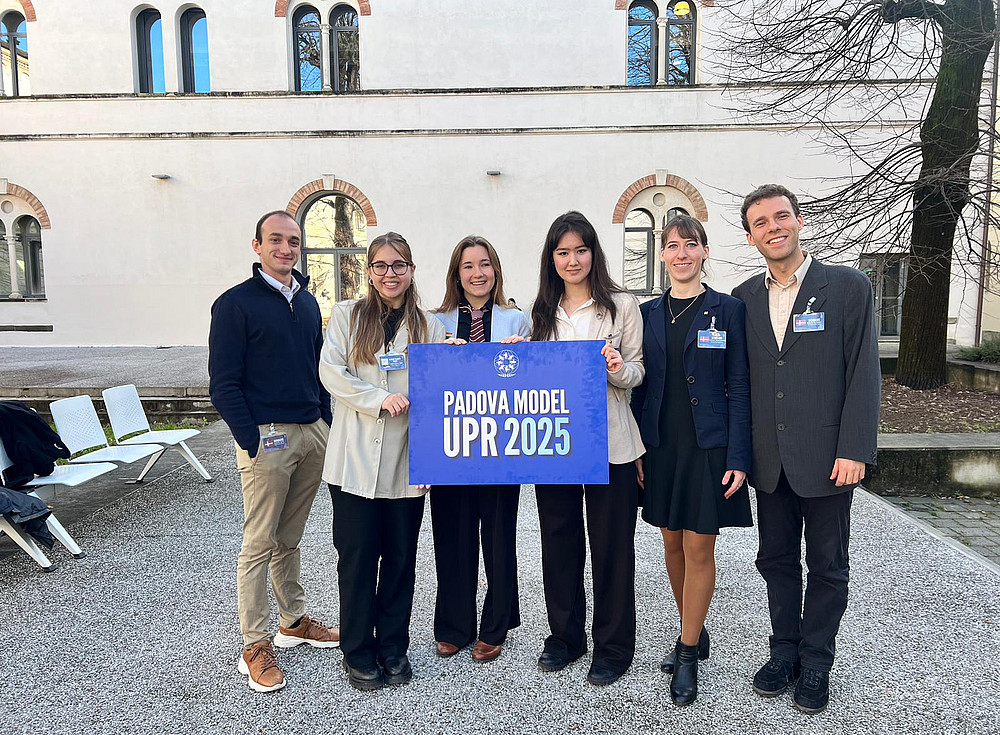
The Universal Periodic Review (UPR) is the central peer-review mechanism of the UN Human Rights Council, through which states assess each other’s human rights records approximately every four and a half years. To familiarise students with the legal, political, and diplomatic dimensions of this process, the University of Padova hosts an annual Model UPR simulation. The programme brings together students from around the world with an interest in human rights, international relations, and diplomacy, allowing them to assume the roles of state delegations and civil society organisations.
Each year, the University of Graz participates with up to nine students, divided into three sub-teams and prepared through a dedicated course offered by the European Training and Research Centre for Human Rights and Democracy (Uni-ETC). Over two months, participants draft written submissions and oral statements, culminating in a week-long simulation that mirrors the full UPR cycle, including lobbying, exchanges between delegations, and the simulation of the Working Group and Item 6 sessions.
This year, University of Graz students took on three roles at the Padova Model UPR. Zhaniya Smagulova and Ioannis Zeris represented Denmark as the State under Review, while Tetiana Voznesenska and Valerio Siciliano acted as the Recommending State for Denmark. Laura Süß and Katharina Lunzer formed the NGO delegation, representing the Human Dignity Trust.
The Denmark delegation achieved second place in the category of State under Review, and the NGO team likewise received second place in its category. These results reflect the participants’ thorough preparation, strong advocacy, and effective engagement throughout the simulation.
Congratulations to all students involved on this well-deserved and successful outcome at this year’s Padova Model UPR!