Begin of page section:
Page sections:

  • Go to contents (Accesskey 1)
  • Go to position marker (Accesskey 2)
  • Go to main navigation (Accesskey 3)
  • Go to sub navigation (Accesskey 4)
  • Go to additional information (Accesskey 5)
  • Go to page settings (user/language) (Accesskey 8)
  • Go to search (Accesskey 9)

End of this page section. Go to overview of page sections

Begin of page section:
Page settings:

English en
Deutsch de
Search
Login

End of this page section. Go to overview of page sections

Begin of page section:
Search:

Search for details about Uni Graz
Close

End of this page section. Go to overview of page sections


Search

Begin of page section:
Main navigation:

Page navigation:

  • University

    University
    • About the University
    • Organisation
    • Faculties
    • Library
    • Working at University of Graz
    • Campus
    Developing solutions for the world of tomorrow - that is our mission. Our students and our researchers take on the great challenges of society and carry the knowledge out.
  • Research Profile

    Research Profile
    • Our Expertise
    • Research Questions
    • Research Portal
    • Promoting Research
    • Research Transfer
    • Ethics in Research
    Scientific excellence and the courage to break new ground. Research at the University of Graz creates the foundations for making the future worth living.
  • Studies

    Studies
    • Prospective Students
    • Students
  • Community

    Community
    • International
    • Location
    • Research and Business
    • Alumni
    The University of Graz is a hub for international research and brings together scientists and business experts. Moreover, it fosters the exchange and cooperation in study and teaching.
  • Spotlight
Topics
  • Sustainable University
  • Researchers answer
  • Work for us
Close menu

End of this page section. Go to overview of page sections

Begin of page section:
You are here:

University of Graz Faculty of Law European Training and Research Centre for Human Rights and Democracy News Ist der Weltfrieden eine Illusion?
  • About the Centre
  • UNESCO Chair
  • Research
  • Teaching
  • News
  • Events

End of this page section. Go to overview of page sections

Monday, 20 June 2022

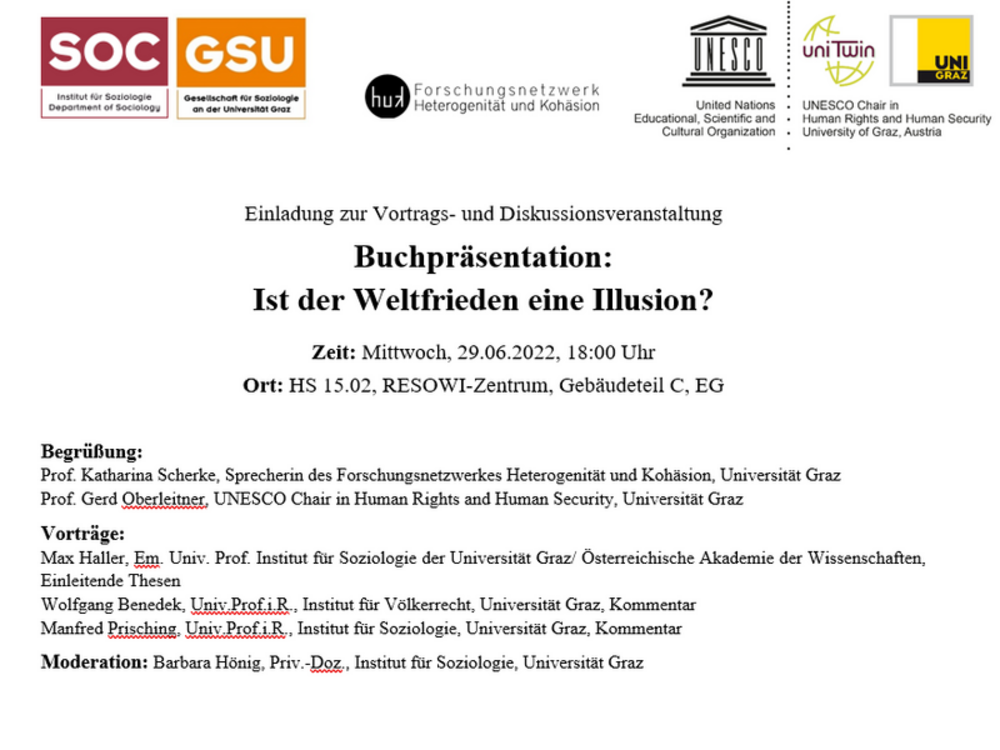
Ist der Weltfrieden eine Illusion?

Buchpräsentation und Diskussion

Wann? 18:00 - 20:30, 29.06.2022

Wo? Hörsaal HS 15.02, Universitätsstraße 15 Bauteil C, Erdgeschoß

Begrüßung:

Prof. Katharina Scherke, Sprecherin des Forschungsnetzwerkes Heterogenität und Kohäsion, Universität Graz

Prof. Gerd Oberleitner, UNESCO Chair in Human Rights and Human Security, Universität Graz

Vorträge:

Max Haller, Em. Univ. Prof. Institut für Soziologie der Universität Graz/ Österreichische Akademie der Wissenschaften, Einleitende Thesen

Wolfgang Benedek, Univ.Prof.i.R., Institut für Völkerrecht, Universität Graz, Kommentar

Manfred Prisching, Univ.Prof.i.R., Institut für Soziologie, Universität Graz, Kommentar

Moderation: Barbara Hönig, Priv.-Doz., Institut für Soziologie, Universität Graz

Mit seinem Aufsatz "Zum ewigen Frieden. Ein philosophischer Entwurf" hat Kant 1795 einen Meilenstein in der Debatte um Krieg und Frieden gesetzt. Der unglaubliche Überfall Russlands auf die Ukraine hat Kants optimistische Thesen erneut auf eine harte Probe gestellt. In seinem soeben erschienenen Werk "Die revolutionäre Kraft der Ideen" argumentiert Max Haller, dass die Argumente von Kant nach wie vor gültig sind. Er folgt darin der These von Max Weber, dass Ideen, neben Interessen, entscheidende Triebkräfte der historischen Entwicklung darstellen. Die militärische Aggression Russlands kann als Nachbeben des expansiven sowjetischen Gewaltregimes gesehen werden, auch die sog. Neuen Kriege sind nur durch das Fehlen demokratischer Institutionen in den jeweiligen Regionen und Ländern zu erklären. Diese Thesen werden von Wolfgang Benedek, einem international renommierten Experten der Menschenrechte, und Manfred Prisching, Autor zahlreicher Bücher über Krisen, Konflikte und sozialen Wandel, diskutiert.

Max Haller, geb. 1947 in Sterzing, war nach Tätigkeiten am Institut für Höhere Studien in Wien und an der Universität Mannheim 1985-2015 Professor für Soziologie an der Universität Graz. Er war Mitbegründer des International Social Survey Programme und der European Sociological Association. Er lehrte an zahlreichen Universitäten in Europa, in den USA und in Tansania. Das Buch, das die Grundlage für diese Veranstaltung bietet, trägt den Titel "Die revolutionäre Kraft der Ideen. Gesellschaftliche Grundwerte zwischen Macht und Interessen, Recht und Moral" (Springer Fachmedien, Juni 2022)

Wolfgang Benedek, geb. 1951 in Knittelfeld, war 2002-2016 Professor und Leiter des Instituts für Völkerrecht der Universität Graz. Er veröffentlichte als Autor und Herausgeber zahlreiche Werke zu den Menschenrechten (u.a. "Menschenrechte verstehen. Handbuch der Menschenrechtsbildung", letzte Auflage 2017). Er war auch Begründer des Europäischen Trainingszentrums für Menschenrechte in Graz und war und ist häufig als Konsulent und Berichterstatter internationaler Organisationen tätig, insbesondere der OSZE.

Manfred Prisching, geb. 1950 in Bruck an der Mur, absolvierte Studien der Rechts- und Volkswirtschaft und habilitierte sich für Soziologie 1985. 1994 bis 2015 war er Professor für Soziologie an der Universität Graz und lehrte auch an amerikanischen Universitäten. 1997-2001 war er wissenschaftlicher Leiter des Technikum Joanneum Graz. Er verfasste zahlreiche Bücher zur allgemeinen Soziologie, zur politischen Soziologie und soziologischen Zeitdiagnose, u.a. das von ihm (mit G. Mikula) herausgegebene Werk "Krieg, Konflikt, Kommunikation. Der Traum von einer friedlichen Welt" (1991).

Related news

Padova Model UPR 2025

Students from University of Graz win second place in two categories at the Model UPR simulation hosted by University of Padua

Call for Registration: 5th Academy and Conference Human Rights Go Local

We cordially invite you to register for the multi-day online participatory forum “Human Rights Go Local: What Works”. The 2026 edition will scrutinize human rights-based budgeting approaches regarding their effectiveness to promote local governments’ accountability. We will discover how these budgeting approaches can serve to make human rights a reality for all.

FreeAc Lecture Series: Circular Economy for Sustainable Development

On 16 December 2025, within the Erasmus+ project Promoting Academic Freedom in Ukraine, coordinated by the University of Graz, a guest lecture by Ukrainian scholar Dr. Kateryna Nesterova took place as part of the Ukrainian Voices lecture series.

Ukrainian study group explores human rights localisation in Graz

Begin of page section:
Additional information:

University of Graz
Universitaetsplatz 3
8010 Graz
Austria
  • Contact
  • Web Editors
  • Moodle
  • UNIGRAZonline
  • Imprint
  • Data Protection Declaration
  • Accessibility Declaration
Weatherstation
Uni Graz

End of this page section. Go to overview of page sections

End of this page section. Go to overview of page sections

Begin of page section:

End of this page section. Go to overview of page sections